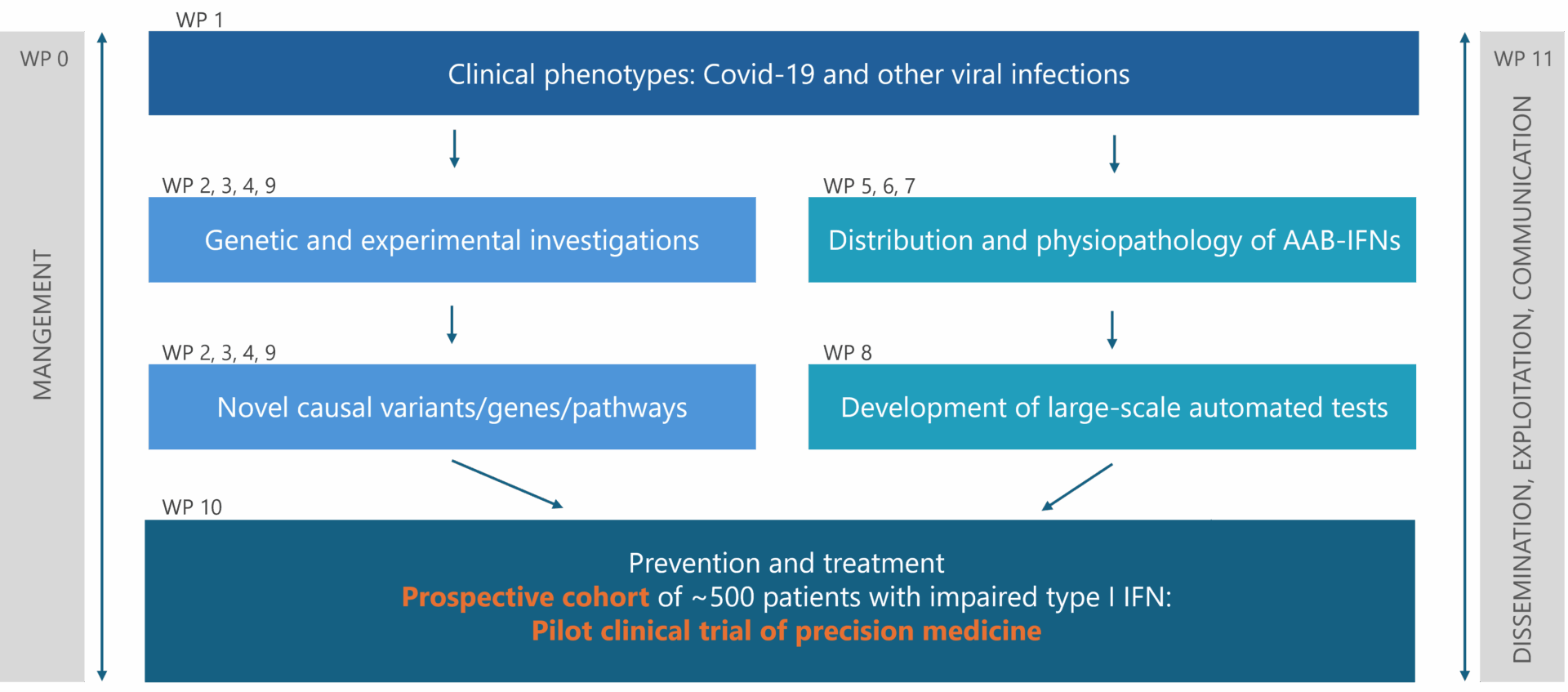
To reach the objectives and comply with their timeline, a workplan with 12 complementary WPs has been defined.
WP 0
Project management administration and coordination
WP 1
Emmanuelle Jouanguy
Clinical cohorts: recruitment and phenotypic definition
Objectives: To define the clinical phenotypes related to SARS-CoV-2 infection and collect curated clinical data and biological material. It includes COVID-19 patients, patients with unexplained severe viral infections, and individuals with inborn errors of immunity (IEI) or autoimmune diseases.
WP 2
Identification of candidate COVID-19 human genotypes by computational approaches
Objectives: To identify genetic variants underlying COVID-19 manifestations through large-scale human genome sequencing. It includes defining high-quality clinical phenotypes to be investigated and selection of appropriate controls, generating robust sequencing data, and investigating monogenic basis of clinical phenotypes using patient-based and cohort-based approaches. Additionally, alternative genetic hypotheses, such as digenic inheritance and physiological homogeneity, will be explored.
WP 3
From candidate COVID19-related genotypes to their immunological validation
Objectives: To characterize the functional impact of candidate variants at the allelic and genomic levels. To define COVID-19 mechanisms involving innate, adaptive, and/or tissue-intrinsic immunity and study the response to SARS-CoV-2 in individuals resistant to infection.
WP 4
Ali Amara
Cellular and immune responses to SARS-CoV-2
Objectives: To characterize population-level variations in immune responses to SARS-CoV-2 at the single-cell level, and quantify the contribution of sex, age, and genetic factors. This aims to create a transcriptional and functional atlas of antigen-presenting cell responses to SARS-CoV-2, analyze the dynamics of immune cell response, and characterize epithelial and endothelial responses to the virus.
WP 5
Pierre Tiberghien
Characterization of individuals with antibodies against type I IFNs and other cytokines
Objectives: To test for the presence of auto-antibodies (auto-Abs) against type I IFNs and other cytokines in the general population, in patients with autoimmune conditions, and in SARS-CoV-2-infected individuals. To test for the neutralizing activity of the auto-Abs among individuals with auto-Ab against type I IFNs or cytokines and evaluate the impact of auto-Abs against type I IFNs or cytokines found in blood products and in transfused patients.
WP 6
Vivien Béziat
Characterization and causes of auto-antibodies against type I IFNs
Objectives: To characterize the clinical, immunological, and genetic features of patients with auto-antibodies against type I IFNs. It includes detailed clinical assessments, deep immunological and epigenetic profiling, and investigations of both germline and somatic causal genetic variants.
WP 7
Guy Gorochov
Matthieu Mahevas
T and B cell responses in severe COVID-19 and MIS-C/A
Objectives: To investigate type I IFN T-cell autoreactivity through epitope mapping, characterize the polyclonal TCR Vβ expansion in MIS-C and its underlying causes, identify IFN-autoreactive B cells, generate patient-derived monoclonal antibodies targeting type I IFN, and expand the search for auto-antibodies beyond type I IFN. These efforts focus on understanding immune dysregulation in diseases like MIS-C.
WP 8
Sophie Trouillet-Assant
Development of novel detection assays for IFNs and auto-antibodies to type I IFNs
Objectives: Monitoring ISG expression in cohorts of patients with COVID-19, life-threatening viral infections, and autoimmune conditions, and evaluating FilmArray technology for rapid ISG monitoring. It aims to develop novel tools for quantifying type I IFN subtypes and anti-type I IFN auto-antibodies, with the goal of transferring validated tools for clinical use within the BIOGROUP laboratory network.
WP 9
Genetic and Immunological investigations of other severe viral infections
Objectives: To recruit patients with severe viral diseases and identify candidate disease-causing gene variants through large-scale human exome sequencing. To characterize at the molecular level these variants and investigate their immunological impact on relevant cell types. To search for auto-antibodies neutralizing type I IFNs or other cytokines in these patients.
WP 10
France Mentré
Clinical research
Objectives: To establish a prospective cohort of individuals with inborn errors or auto-antibodies to type I IFNs and monitor the longitudinal evolution of these auto-Abs. It seeks to identify markers or risk factors for infectious or autoimmune events in these individuals. To perform a pilot clinical trial of precision medicine in SARS-CoV-2-infected individuals within the cohort.
WP 11
Dissemination, communication and exploitation
Objectives: To define and implement an efficient strategy for scientific dissemination to professionals and the general public, while also protecting and exploiting intellectual property rights.
COVIFERON relies on an integrated innovative strategy